

- ISO 9001 - 2015 Certified
- PED 2014/68/EC
- NACE MR0175/ISO 15156-2
- NORSOK M-650
- DFAR
- MERKBLATT AD 2000 W2/W7/W10
A286 Stainless Steel, UNS S66286 / Alloy A-286
A286 (also written A-286, Alloy A286, Iron Alloy 660, UNS S66286, DIN 1.4980, X5NiCrTiMoVB25-15-2) is an iron-nickel-chromium precipitation-hardening austenitic stainless steel superalloy. Nominal composition is 53 Fe – 25 Ni – 15 Cr – 2 Ti – 1.3 Mo with small additions of vanadium, aluminium and boron. The alloy is age-hardenable, non-magnetic and oxidation-resistant. It retains tensile strength ≥ 620 MPa (90 ksi) at 700 °C (1300 °F) and is used in aerospace jet-engine fasteners, industrial gas-turbine hardware, turbocharger wheels, oil & gas downhole tools, and cryogenic and nuclear service. A286 is covered by ASTM A453 grade 660, ASTM A638 grade 660, ASTM B637, and AMS 5525 / 5731 / 5732 / 5734 / 5736 / 5737 / 5853 / 5895.
Incoloy® Alloy A286 is iron-nickel-chromium based austenitic iron based material that consist of molybdenum and titanium as an addition. Cres A286 alloy is known for its good strength and oxidation resistance especially at temperatures up to 1300°F (700°C). A286 is an age-hardenable iron-nickel-chromium alloy that is one of the most popular and widely used of high temperature alloys. It maintains good strength with oxidation resistance at temperatures of up to 1300°F. A286 is used in various components, such as aircraft and industrial gas turbines due to its high strength and superior fabrication. A286 is also very popular in offshore oil and gas industry where high levels of heat and stress are a factor.
Incoloy® Alloy A286 is iron-nickel-chromium based austenitic iron based material that consist of molybdenum and titanium as an addition. Cres A286 alloy is known for its good strength and oxidation resistance especially at temperatures up to 1300°F (700°C). A286 is an age-hardenable iron-nickel-chromium alloy that is one of the most popular and widely used of high temperature alloys. It maintains good strength with oxidation resistance at temperatures of up to 1300°F. A286 is used in various components, such as aircraft and industrial gas turbines due to is high strength and superior fabrication. A286 is also very popular in offshore oil and gas industry where high levels of heat and stress are a factor.
A286 Stainless Steel Characteristics & Key Properties
- Good machinability
- Excellent fabrication characteristics
- Good oxidation resistance up to 800°C
- Can be produced by AOD reefing or vacuum induction melting
- Good creep-rupture strength during extended high-temperature exposure
- Non-magnetic even after severe cold deformation
- High ductility in notched sections
- Very high corrosion resistance
- Good for moderate corrosion applications in aqueous solutions
- High mechanical properties due to age-hardenability
- Good creep-rupture strength during extended high-temperature exposure
- High strengths that are well retained up to 700°C
A286 Equivalent Grades & Trade Names (Iron Alloy 660 / Incoloy A286 / Pyromet A286)
Incoloy Alloy A286 (® Special Metals)
Pyromet Alloy A286 (® Carpenter Technology)
ATI A286 (™ Allegheny Technologies)
TURBALOY® 286VM(United States Welding Corporation)
A286 Chemical Composition (UNS S66286 Element Ranges)
A286 chemistry per ASTM A453 grade 660, ASTM A638 grade 660, DIN EN 10269 and VdTÜV-Werkstoffblatt 435. Full element-by-element ranges are also detailed on our dedicated A286 chemical composition page.
| Elements | DIN EN 10269 | VdTÜV Werkstoffblatt 435 |
ASTM A453 Grade 660 A/B/C/D |
|---|---|---|---|
| Carbon (C), max. | 0.03 - 0.08 | 0.08 | 0.08 |
| Manganese (Mn), max. | 1.00 - 2.00 | 2.00 | 2.00 |
| Phosphorous (P), max. | 0.025 | 0.030 | 0.040 |
| Sulphur (S), max. | 0.015 | 0.030 | 0.030 |
| Silicon (Si), max. | 1.00 | 1.00 | 1.00 |
| Chromium (Cr) | 13.5 - 16.0 | 13.5 - 16.0 | 13.5 - 16.0 |
| Nickel (Ni) | 24.0 - 27.0 | 24.0 - 27.0 | 24.0 - 27.0 |
| Molybdenum (Mo) | 1.00 - 1.50 | 1.00 - 1.50 | 1.00 - 1.50 |
| Titanium (Ti) | 1.90 - 2.30 | 1.9 - 2.3 | 1.90 - 2.35 |
| Aluminium (Al), max. | 0.35 | 0.35 | 0.35 |
| Vanadium (V) | 0.10 - 0.50 | 0.10 - 0.50 | 0.10 - 0.50 |
| Boron (B) | 0.003 - 0.010 | 0.003 - 0.010 | 0.001 - 0.010 |
A286 Physical Properties, Density, Modulus, Thermal Expansion
Density: 0.287 lb/in3, (7.94 g/cm3)
Modulus of Elasticity (E): At 70°F (20°C): 28.8 x 10³ ksi (199
GPa)
Modulus of Rigidity (G): At 70°F (20°C): 11.2 x 10³ ksi (77.0 GPa)
Coefficient of Expansion: 9.47 µin/in.-°F (70°F to 600°F) | 17.0
µm/m-°C (20°C to 300°C)
Electrical Resistivity: 35.8 µΩ.in, (91 µΩ.cm)
Thermal Conductivity: 88 Btu-in/ft2hr-°F, (12.7 W/m-K)
A286 Mechanical Properties, Yield Strength, Tensile Strength, Hardness
Room-temperature tensile, yield, hardness and elongation values per A286 mechanical properties (yield strength · tensile strength · hardness · density · elongation):
| Solution Annealed / Precipitation Hardened |
Bar | Forged Bar / Forgings | Bar |
|---|---|---|---|
| D ≤ 160 mm | D ≤ 300 mm | Typical | |
| Tensile Strength Rm (MPa) | 900 - 1150 | 900 - 1200 | ≥ 895 |
| Yield Stress Rp 0.2 (MPa) | ≥ 600 | ≥ 600 | ≥ 585 |
| Elongation L=4d (%) | l ≥ 15 | l ≥ 16, q ≥ 14 | ≥ 15 |
| Reduction Z (%) | ≥ 18 | ||
| Charpy Notch Impact Av (J) | ≥ 50 | l ≥ 56, q/t ≥ 32 | |
| Hardness (BHN) | 248 - 341 |
A286 Stress Rupture Strength at Elevated Temperature
A286 alloy is designed to withstand elevated temperature strength. Typical Creep Strength and stress rupture strengths of material aged at 1325°F (718°C) are shown below. Two Different type solution treatments are used to achieve respective stress rupture properties viz:
ASTM A638 Grade 660 Type 2; ASTM A453 Grade 660 Class B; ASTM A891 Type 2; AMS 5732)
For high stress rupture strength Solution treat at 1800°F (982°C) for 1 hour, rapid cool, age at 1325°F (718°C) for 16 hours and air cool.
ASTM A638 Grade 660 Type 1; ASTM A453 Grade 660 Class A, ASTM A891 Type 1; AMS 5737
For high room temperature tensile strength and stress rupture ductility, Solution treat at 1650°F (899°C) for 2 hour, rapid cool, age at 1325°F (718°C) for 16 hours and air cool.
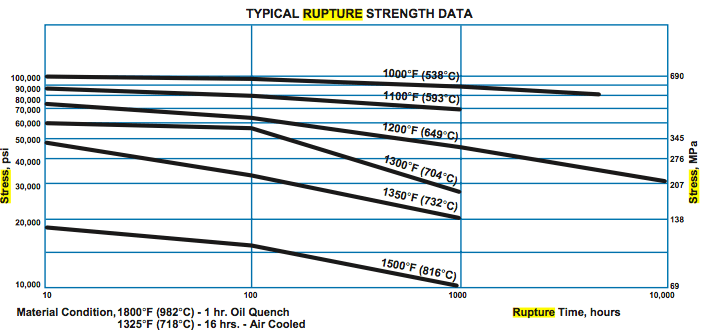
Typical Stress Rupture Strength Chart
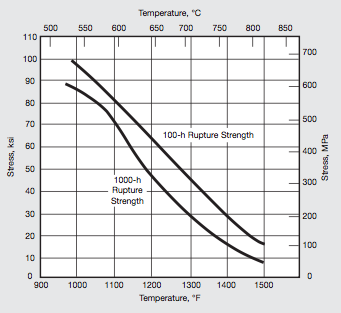
Cres A286 Stress Rupture Test
| Degrees Fahrenheit | Degrees Celcius | 100 Hours | % elongation in 3D | 1000 Hours | %,elongation in 4D | ||
|---|---|---|---|---|---|---|---|
| Ksi | Mpa | Ksi | Mpa | ||||
| 1000 °F | 538 °C | 99 Ksi | 683 Mpa | 3% | 88 Ksi | 607 Mpa | 3% |
| 1100 °F | 593 °C | 81.5 Ksi | 562 Mpa | 3% | 71.5 Ksi | 493 Mpa | 3% |
| 1200 °F | 639 °C | 61 Ksi | 421 Mpa | 5% | 46 Ksi | 317 Mpa | 8.5 % |
| 1300 °F | 704 °C | 44.5 Ksi | 307 Mpa | 12 % | 29 Ksi | 200 Mpa | 30 % |
| 1350 °F | 732 °C | 35 Ksi | 41 Mpa | 29 % | 21 Ksi | 145 Mpa | 35 % |
| 1500 °F | 816 °C | 13 Ksi | 90 Mpa | 55 % | 7.7 Ksi | 53 Mpa | - |
A286 Creep Strength at 540-700 °C Service
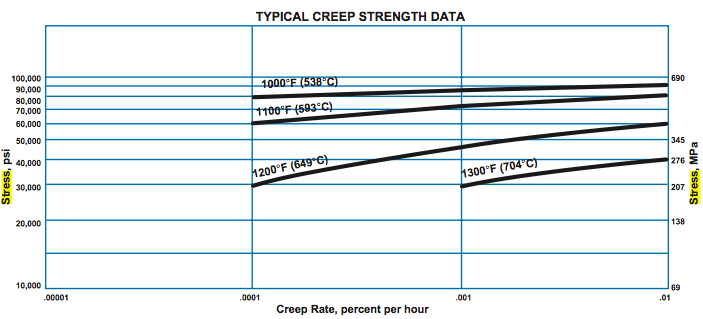
Typical Creep Strength Chart
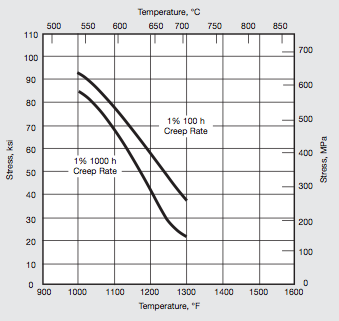
Cres A286 Creep Strength
A286 Heat Treatment, Solution + Precipitation Aging Schedule
A286 is supplied solution-treated and precipitation-aged. Two solution conditions are common: 1650 °F (899 °C) per AMS 5737 / ASTM A453 Class A for higher room-temperature tensile, and 1800 °F (982 °C) per AMS 5732 / ASTM A453 Class B for higher stress-rupture strength. Both are aged at 1325 °F (718 °C) for 16 hours. Full schedule on our A286 heat treatment page.
| Step | Temperature | Hold | Cool | Specification |
|---|---|---|---|---|
| Solution (Class A) | 1650 °F (899 °C) | 1–2 h | Oil quench | AMS 5737 / ASTM A453 Cl. A / ASTM A638 Type 1 |
| Solution (Class B) | 1800 °F (982 °C) | 1 h | Rapid cool | AMS 5732 / ASTM A453 Cl. B / ASTM A638 Type 2 |
| Aging | 1325 °F (718 °C) | 16 h | Air cool | All classes |
A286 Corrosion Resistance in High-Temperature Service
A286 Alloy has corrosion resistance similar to austenitic stainless steels in many environments. Cres-A286 has superior corrosion resistance to nickel-base alloys when exposed to sulfur contaminated atmospheres at elevated temperatures.The corrosion resistance of this alloy is excellent up to 1300 °F(704 °C) against many atmospheres encountered in jet engine service. Up to 1800 °F(982 °C), the oxidation resistance of alloy A286 is equivalent to that of 310 Stainless Steel.
A286 Oxidation Resistance to 982 °C (1800 °F)
Cres A286 has excellent oxidation resistance up to 1,800°F (982°C). High temperature sustainability and high tensile strength is the key factor for superior Oxidation resistance property of Alloy A286.
A286 Fabrication for Aerospace and Industrial Components
Due to the high strength and reliable fabrication characteristics of Cres A286, It is widely used in manufacturing and fabrication of various components used in turbines mainly in gas industry and aircraft applications . It is also used for fastener applications in automotive engine and manifold components subject to high levels of heat and stress and in the offshore oil and gas industry.
A286 Forging, Process, Temperature Range, Grain Flow
Alloy A286 steel has similar forging properties as compared to
austenitic stainless steels. Initial forging is usually performed from 2,000- 2,150°F
(1,093 - 1,177°C) with finishing temperatures from 1,650-1,700 F (899 - 927°C).15 - 20
percent minimum reduction should be combined with a low finishing temperature to
produce a fine, uniform grain size. The formability of Alloy A286 alloy in the solution
annealed condition is similar to Type 310 stainless steel.
ATI A286TM alloy in the solution annealed condition is similar to ATI 310 stainless
steel.
A286 Machinability, Cutting Parameters & Tool Selection
Being and austenitic Stainless Steel with 24 percent nickel
content, Alloy A286 is an iron-base alloy which is easier to machine as compared to
nickel-based precipitation-hardening steels.
The machinability of Alloy A286 is similar to that of the austenitic stainless steels
specifically Stainless steel type 310. Cres Alloy A286 is usually machined in the full
aged or partially aged condition.
Carbide insert tools are commonly used for machining Alloy 286.
A286 Weldability, TIG / MIG with AMS 5853 Filler
Alloy A286 steel can be welded in the solution annealed condition in thin sections, and in large sections under conditions of low restraint. However, the alloy is subject to hot cracking, particularly in the aged condition. Sound welds can be produced by inert gas shielded arc, spot, resistance seam, ash butt, and electron beam welding techniques.
A286 AMS / ASTM / UNS / DIN Specifications Cross-Reference
Complete specifications cross-reference for A286 (UNS S66286). Click any spec to see the full reference page covering scope, chemistry, heat-treatment, mechanical properties, and applications. See the consolidated A286 AMS / ASTM Specifications hub for the complete reference.
| Designation | Standard / Spec | Form / Condition | Equivalent |
|---|---|---|---|
| UNS S66286 | UNS | Generic A286 | All forms |
| 1.4980 | DIN / Werkstoff Nr. | X5NiCrTiMoVB25-15-2 | DIN 17240 |
| Iron Alloy 660 | ASTM A453 grade 660 | High-temp bolting (Cl. A/B/C/D) | UNS S66286 |
| 660 | ASTM A638 grade 660 | Forgings (Type 1 / Type 2) | UNS S66286 |
| ASTM B637 | Precipitation-hardenable bar | UNS S66286 | |
| AMS 5525 | SAE / AMS | Sheet, strip & plate, sol-treated | |
| AMS 5731 | SAE / AMS | Bars, forgings, tubing, rings, sol 1800 °F | |
| AMS 5732 | SAE / AMS | Bars, forgings, tubing, sol 1650 °F + aged | |
| AMS 5734 | SAE / AMS | Bars, sol-treated | |
| AMS 5736 | SAE / AMS | Bars & forgings, sol-treated | |
| AMS 5737 | SAE / AMS | Bars, sol 1650 °F + precipitation aged | |
| AMS 5853 | SAE / AMS | Welding wire (matching A286) | |
| AMS 5895 | SAE / AMS | Sheet / strip, aged | |
| SAE J467 | SAE | A-286 commercial designation |
A286 vs Inconel 718 vs Waspaloy vs 17-4 PH, Material Comparison
Detailed side-by-side comparisons: A286 vs Inconel 718 · A286 vs 17-4 PH · A286 vs Waspaloy · A286 vs Nimonic 80A · A286 equivalent grades reference. Engineers selecting a precipitation-hardening alloy for jet-engine bolting, gas-turbine wheels, or high-temperature springs typically compare A286 against Inconel 718, Waspaloy and 17-4 PH:
| Property | A286 (UNS S66286) | Inconel 718 (UNS N07718) | Waspaloy (UNS N07001) | 17-4 PH (UNS S17400) |
|---|---|---|---|---|
| Base | Fe-Ni-Cr (Fe-base) | Ni-Fe-Cr (Ni-base) | Ni-Cr-Co (Ni-base) | Fe-Cr-Ni (Fe-base) |
| Density (g/cm³) | 7.94 | 8.19 | 8.19 | 7.80 |
| Max service °C | ~700 | ~700 | ~870 | ~315 |
| Yield (RT) MPa | ≥ 585 | ≥ 1034 | ≥ 795 | ≥ 1170 |
| Tensile (RT) MPa | ≥ 895 | ≥ 1276 | ≥ 1275 | ≥ 1310 |
| Magnetic | No | No | No | Yes (martensitic) |
| Cost (relative) | 1.0× | 2.5–3.5× | 4–6× | 0.6–0.8× |
| Welding | Good (sol-treated) | Excellent (vs strain-age cracking) | Limited | Good |
| Best for | Lower cost than 718, ≤ 700 °C, non-magnetic | ≤ 700 °C, highest-strength bolting | 650–870 °C turbine discs | ≤ 315 °C corrosion + strength |
When to choose A286: highest cost-performance for non-magnetic precipitation-hardening service ≤ 700 °C, jet-engine fasteners, gas-turbine compressor hardware, automotive turbocharger and oil & gas service. When to choose Inconel 718: when room-temperature tensile ≥ 1240 MPa is required and higher cost is acceptable. When to choose Waspaloy: for sustained service above 700 °C. When to choose 17-4 PH: when service stays below ~315 °C and magnetic response is acceptable. For sour-service H2S environments where elevated-temperature strength is not the priority: see Incoloy 925 (UNS N09925), an age-hardenable nickel-iron-chromium alloy qualified under NACE MR0175 / ISO 15156-3 for H2S service up to 0.2 bar partial pressure.
A286 Specifications by Form, AMS / ASTM Spec Reference per Product
Seamless Pipe & Tube
Rod / Bar
- BS HR 52
- BS HR 560
- DTD 5076
- EZ 6NCT25-15
- GEB50T1181
- GEB50T12
- GEB50T81
- SAE J467-A286 (UNS S66286)
Wire
Forgings
A286 Applications by Industry, Jet Engine, Gas Turbine, Nuclear, Aerospace
Application-specific reference pages: A286 jet engine fasteners · A286 gas turbine applications · A286 nuclear applications · A286 aerospace fasteners.
Cres A286 Applications Product Wise
- Pumps & High Pressure Components
- Other Power Generation Components
- Wellhead, X-mas trees & Manifolds (incl. Tubing hangers), BOPs
- Flowlines & Connectors
- Valves & Actuators
- Comp. for Chemical plants (incl. LNG, FGD, Urea, LDPE, etc.)
- Tubular Products, Flanges, Fittings
- Forging Applications
- Lamps/Lenses for Automotive
- Fasteners, Bolts & Nuts
- Turbine and Engine Parts (Aerosp)
- Blades & Shafts for Turbines and Compressors
- Comp. for Industrial Gas Compressors
- Steam Valves
- Aircraft components
- Non-magnetic low-temperature Cryogenic equipments (-423º F)
- shafts
- Compressors
- After burner parts
- Manifold Components in the oil and gas industry
- Jet engine components
Cres A286 Applications Industry Wise
- Aerospace
- Building Industry
- Oil & Gas
- Thermal Process Engineering
- Automotive Industry
- Power Generation
- Offshore Industry
- Marine Industry
A286 Frequently Asked Questions
What is Alloy A286?
Alloy A286 (UNS S66286, DIN 1.4980, X5NiCrTiMoVB25-15-2) is an iron-nickel-chromium precipitation-hardening austenitic stainless steel superalloy. Nominal composition is 53Fe-25Ni-15Cr-2Ti-1.3Mo. It retains tensile strength ≥ 620 MPa at 700 °C and is non-magnetic.
What is A286 alloy equivalent to?
A286 is equivalent to UNS S66286, DIN 1.4980, Iron Alloy 660, Incoloy® A286, Pyromet® A286, ATI A286™, Tinidur. Covered by ASTM A453 grade 660 / A638 / B637 and AMS 5525-5895.
Is A286 considered stainless steel?
Yes, A286 is both an austenitic stainless steel (13.5–16% Cr) and an iron-base superalloy. It sits at the boundary of the two families.
Is iron alloy 660 the same as A286?
Yes. Iron Alloy 660 is the ASTM A453 grade-660 designation for the same alloy as A286 / UNS S66286.
Is A286 magnetic?
No. A286 is non-magnetic in both solution-treated and aged conditions, with permeability ≈ 1.001 even after severe cold work.
What is the density of A286?
Density of A286 is 7.94 g/cm³ (0.287 lb/in³). Modulus of elasticity at room temperature is 199 GPa. See full A286 mechanical properties.
Can A286 be welded?
Yes, TIG/MIG, spot, resistance-seam, flash-butt and electron-beam in the solution-annealed state. Filler is matching A286 welding wire (AMS 5853). Aged condition is hot-crack sensitive.
What is the difference between AMS 5731, AMS 5732 and AMS 5737?
All three are A286 (UNS S66286) bar/forging specifications, but they define different solution & aging treatments. AMS 5731 = sol-treated 1800 °F. AMS 5732 = sol 1650 °F + aged. AMS 5737 = sol 1650 °F + precipitation-aged for tensile. See full AMS / ASTM specification hub.
What is equivalent to UNS S66286?
UNS S66286 ≡ A286 / Alloy A-286 / Iron Alloy 660 / DIN 1.4980 / X5NiCrTiMoVB25-15-2 / ASTM A453 gr 660 / ASTM A638 gr 660 / Werkstoff 1.4980. All refer to the same iron-nickel-chromium precipitation-hardening superalloy.
What is another name for A286 steel?
Iron Alloy 660, Alloy 660, A-286, UNS S66286, DIN 1.4980, X5NiCrTiMoVB25-15-2, Incoloy® A286, Pyromet® A286, ATI A286™, Tinidur, Discaloy.
In which forms is A286 supplied?
TorqBolt manufactures A286 in fasteners, bar, rod, wire, sheet, plate, tubes, springs and forgings.
What is A286 used for? Service temperature?
A286 is used in jet-engine fasteners, industrial gas turbines, turbocharger wheels, oil & gas downhole tools, nuclear reactor internals, cryogenic service. Range: −196 °C to ~700 °C (oxidation-resistant to 982 °C).
Satisfaction Survey